
Cairo City
Cairo is Egypt's capital and hub of cultural, social, intellectual, economic & political activity, standing where east meets west and combining the mystery of the one with the sophistication of the other. It is a city of contrasts; a place where donkey carts jockey with Mercedes along the crowded streets, and where a thousand minarets adorn the skyline alongside a sea of skyscrapers.
It is the largest city in the African continent and the heart of the Arab world with a population of 16,000,000. With its "thousand minarets", picturesque oriental bazaars, plush Nile-side hotels, apartment blocks, and gracious residential areas, it is a fascinating combination of modern and ancient civilizations, which together give Cairo a unique atmosphere.
The Egyptian Museum
One of the world's greatest Museums, it allows the visitor to become acquainted with the Antiquities of Egypt's Pharaonic period. Artifacts and Monuments on display date back some 50 Centuries before our time. The Egyptian Museum was built during the reign of Khedive Abbass Helmi II in 1897, and opened its doors on November 15, 1902. Today, the museum contains the most important collection of Egyptian antiquities in the world. Exhibited are over 120,000 objects from the Pharaonic and Greco-Roman periods, including the celebrated mummies of ancient Egyptian kings and the treasures of King Tut Ankh Amun. A special ‘Hidden Treasures’ exhibit in the museum’s re-designed basement features more than 150 artifacts on display for the first time
Memphis
Memphis, founded around 3,100 BC, is the legendary city of Menes, the King who united Upper and Lower Egypt. Early on, Memphis was more likely a fortress from which Menes controlled the land and water routes between Upper Egypt and the Delta. Having probably originated in Upper Egypt, from Memphis he could control the conquered people of Lower Egypt. However, by the Third Dynasty, the building at Saqqara suggests that Memphis had become a sizable city. Today, nothing much remind from ancient Memphis, except some monuments from the new kingdom period and later period. In Memphis, the open- air museum exhibits a limestone colossus of king Ramsis II (1305-1237 BC ) and I giant alabaster sphinx weighting more than 80 tons of weight, that once stood out side the massive temple of god Petah.
Sakkara
Sakkara is one section of the great necropolis of Memphis, the Old Kingdom capital and the kings of the 1st Dynasty as well as that of the 2nd Dynasty. are mostly buried in this section of the Memphis necropolis. It has been of constant interest to Egyptologists.
The Great Pyramids & Sphinx
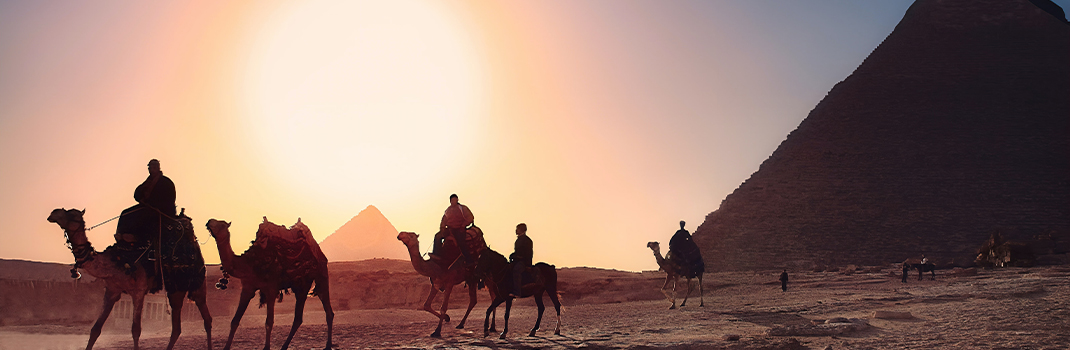
The Giza necropolis, situated in the immediate vicinity of the southwestern suburbs of modern Cairo is probably one of the most famous ancient sites in the world. Main attractions at Giza plateau are the Great Pyramids & Sphinx.
Pyramids of Dahshur
Dahshur was a main breeding ground for the pyramid age. Here we find several pyramids, including two Old Kingdom pyramids both unique, and both a distinct phase in the evolution of pyramid building and the pyramid complex. King Sneferu (about 2600-2450) father of Khufu, was the curious builder of these pyramids, The Bent Pyramid earned its name from its distinct change in angle. The pyramid was began at an angle of 52 degrees and midway through its construction this angle was suddenly and still inexplicably changes to the safer angle of 43 degrees. this change in angle in the Bent pyramid would come for a different reason. Whatever the reason is, King Sneferu began a second pyramid at Dahshur, north of this first pyramid. This second pyramid, now called the Northern or Red Pyramid, was completely built at the angle of 43 degrees, as with the top portion of the Bent Pyramid.
Sound & light show at the Pyramids
Inaugurated in 1961, the show begins with the story of The Sphinx who has been the vigilant guardian of the city of the dead for five thousand years. The show depicts the story of building the pyramids of Cheops, Chephren, Mycherinos and relates the history of great and famous figures of ancient Egypt such as Thutmosis IV, Akhnaten, Nefertiti and Tutankhamon