
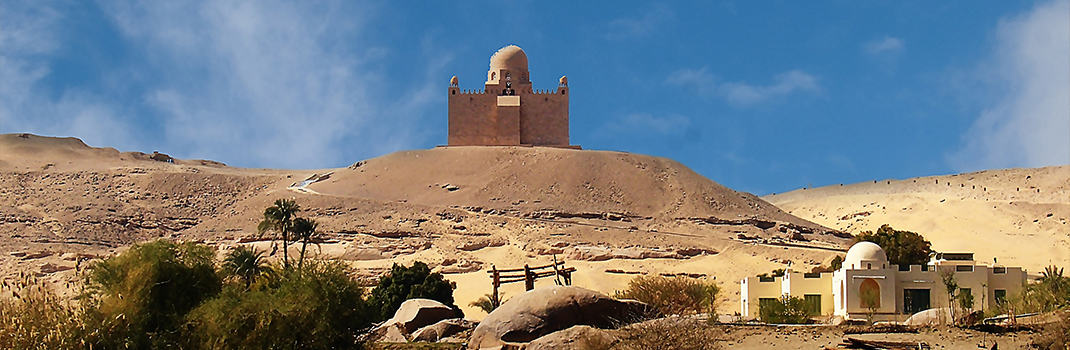
Aswan
Aswan, Egypt's sunniest southern city and ancient frontier town located about 890 km south of Cairo, it has a distinctively African atmosphere. It is the starting and ending point of Nile cruises today. In ancient times, Aswan was known as Syene, the southern border of Pharaonic Egypt. Syene was the center of trade between Egypt, adjoining Nubia and the rest of southern Africa. During these times, the city supplied granite for several of the temples of Egypt, there days can be spent strolling up and down the broad Corniche watching the sailboats etch the sky with their tall masts or sitting in floating restaurants listening to Nubian music and eating freshly caught fish
Kitchener’s island (Botanical Garden)
Kitchner's Island is a botanical garden, filled with exotic plants and trees imported from all over the world. It is a perfect place to spend a lazy afternoon in the shade. The island must be reached by boat, and is located on the other side of Elephantine Island from Aswan. The Island was given to Lord Kitchener for his campaigns in the Sudan, and he moved their and created his garden, importing plants and trees from all over the world. Today, the Egyptian government operates this popular tourist destination
Philae Temple
Once renowned as the (The Pearl of Egypt) by virtue of its rich Vegetation & its magnificent assemblage of temples The island of Philae now lies beneath the waters of Lake Nasser; but fortunately thanks to a spectacular rescue operation carried through with financial & technical assistance from Italy and West Germany, it was possible to save at least the most important monuments & re-erect them on the higher neighbor island of Agilka, Although antiquities on the island date between the 26th Dynasty and the Roman Period, most of the work is from that of the Roman. This was a time of immense popularity of the Goddess Isis, and this was her island, where pilgrims would come from all over the Mediterranean. Construction on the island took place over an 800 year span, and it was one of the last strongholds of Ancient Egyptian Religion which continued to flourish here into the 6th Century. When the Temples where finally closed by Justinian in A.D 550, it ended 4,000 years of worship of the pagan gods.
Unfinished Obelisk
Much of the red granite used for ancient temples and colossi came from quarries in the Aswan area. Around these quarries are many inscriptions, many of which describe successful quarrying projects. The Unfinished Obelisk located in the Northern Quarry still lies where a crack was discovered as it was being hewn from the rock. Possibly intended as a companion to the Lateran Obelisk, originally at Karnak but now in Rome, it would have weighed over 2.3 million pounds and would have been the worlds largest piece of stone ever handled. However, a crack in the stone occurred, which caused it to be abandoned. Tools left by it's builders have given us much insight into how such work was performed
High Dam
Located near Aswan, the world famous High Dam was an engineering miracle when it was built in the 1960s. It contains 18 times the material used in the Great Pyramid of Cheops. The Dam is 11,811 feet long, 3215 feet thick at the base and 364 feet tall. Today it provides irrigation and electricity for the whole of Egypt and, together with the old Aswan Dam built by the British between 1898 and 1902`, 6km down river, wonderful views for visitors. From the top of the two Mile long High Dam you can gaze across Lake Nassar, the huge reservoir created when it was built, to Kalabsha temple in the south and the huge power station to the north
St. Simeon Monastery
This abandoned monastery near the Agha Khan Mausoleum on the west bank at Aswan is considered to be notably typical of early Christian Monasteries, It is very likely that this will also include one substantial camel ride (about 15 minutes), it was one of the largest Coptic Monasteries in Egypt, begun in the 6th century, but it is believed that most building took place in the 7th century. It was first dedicated to Amba Hadra (Amba Samaan, Anba Hadra) a bishop of Aswan and saint of the late 4th century. This fortress Christian monastery originally had walls ten meters tall, with keeps or towers which were used as lookout posts against enemies, the monastery was rebuilt in the 10th century, but destroyed in 1173 by Saladin who feared that it might serve as a refuge of marauding Christian Nubians who made forays into southern Egypt
Nubian Museum
The Nubia Museum is deemed to be one of the most important Egyptian museums. A number of factors have combined together, yielding the magnificence of such museum, as it is the only unique open museum of its kind, The International Museum of Nubia is located in Aswan on an area of 50,000 square largest part occupied by the monumental pieces, reflecting phases of the development of the Nubian culture and civilization, Three thousands pieces of antique., representing various ages; Geological, Pharaonic, Roman, Coptic and Islamic, were registered. The open-door exhibition includes 90 rare monumental pieces, while the internal halls contain 50 invaluable pieces dating back to the pre-history times, 503 pieces belong to Pharaonic time, 52 of Coptic era, 103 of Islamic age, 140 of Nubian time, in addition to 360 pieces having the tang of Aswan.